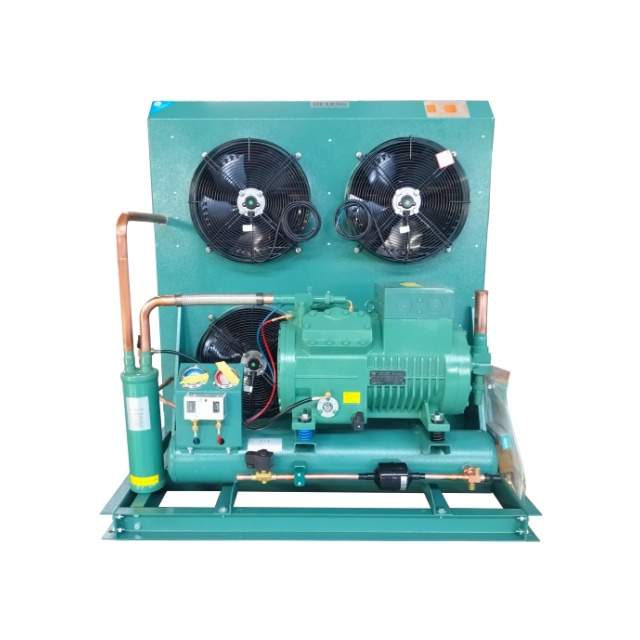
Semi-hermetic Reciprocating Compressor Unit
tianshun
| Availability: | |
|---|---|
| Quantity: | |
|
Product Description
Reciprocating compressors, also known as piston compressors, are vital tools across various industries. Renowned for their efficiency and reliability, these machines are essential for operations that require consistent and powerful compressed air.

|
What is a Reciprocating Compressor?
A reciprocating compressor works by converting power into potential energy stored in pressurized air. It achieves this through a piston driven by a crankshaft. The piston moves down to draw air into the cylinder, then moves up to compress it. This simple yet effective mechanism is why reciprocating compressors are favored for many applications.
|
Application scenarios
|
Key Benefits
High Pressure and Efficiency: Reciprocating compressors can achieve high pressures, making them suitable for heavy-duty applications. Their efficiency in compressing air also means they consume less energy compared to other compressor types.
Durability and Longevity: Built to withstand tough conditions, these compressors offer long service life with proper maintenance. Their robust construction ensures reliability even in demanding environments.
Versatility: These compressors are used in various industries, from manufacturing and construction to automotive and food processing. Their ability to handle a wide range of pressures and flow rates makes them incredibly versatile.
Low Initial Cost: Compared to other types of compressors, reciprocating compressors generally have a lower initial cost. This makes them an attractive option for businesses looking to maximize their return on investment.
|
Working Principle of Reciprocating Compressors
Boyle’s law states that the absolute pressure exerted by a given mass of an ideal gas is inversely proportional to the volume it occupies if the temperature and amount of gas remain unchanged within a closed system. This law shows us that a gas-like air will increase its pressure as it passes through an enclosed space of decreasing size. The pressure and volume relationship is inversely proportional.
|
Product Description
Reciprocating compressors, also known as piston compressors, are vital tools across various industries. Renowned for their efficiency and reliability, these machines are essential for operations that require consistent and powerful compressed air.

|
What is a Reciprocating Compressor?
A reciprocating compressor works by converting power into potential energy stored in pressurized air. It achieves this through a piston driven by a crankshaft. The piston moves down to draw air into the cylinder, then moves up to compress it. This simple yet effective mechanism is why reciprocating compressors are favored for many applications.
|
Application scenarios
|
Key Benefits
High Pressure and Efficiency: Reciprocating compressors can achieve high pressures, making them suitable for heavy-duty applications. Their efficiency in compressing air also means they consume less energy compared to other compressor types.
Durability and Longevity: Built to withstand tough conditions, these compressors offer long service life with proper maintenance. Their robust construction ensures reliability even in demanding environments.
Versatility: These compressors are used in various industries, from manufacturing and construction to automotive and food processing. Their ability to handle a wide range of pressures and flow rates makes them incredibly versatile.
Low Initial Cost: Compared to other types of compressors, reciprocating compressors generally have a lower initial cost. This makes them an attractive option for businesses looking to maximize their return on investment.
|
Working Principle of Reciprocating Compressors
Boyle’s law states that the absolute pressure exerted by a given mass of an ideal gas is inversely proportional to the volume it occupies if the temperature and amount of gas remain unchanged within a closed system. This law shows us that a gas-like air will increase its pressure as it passes through an enclosed space of decreasing size. The pressure and volume relationship is inversely proportional.