| Availability: | |
|---|---|
| Quantity: | |
A water- cooled condenser is a chiler component that removes heat fromindustrial processes. t transfers heat rom the refigerant to water, which thencirculates to a cooling tower or heat exchanger. This method ofers efficient heat removal, especially in high-heat environments, making it ideal forequipment that reguires stable temperatures, Regular maintenance, such as cleaning condenser tubes and monitoring water qualty, is important foroptimal performance.
In addition to water-cooled, there are also air-cooled and evaporative condensers. However, all condensers have asimilar function, regardless of type. Their job is to cool a process or equipment by transferring heat away from arefrigerant gas.
Air-cooled condensers use ambient air to cool the refrigerant, Fans blow air over the condenser coils, which releaseheat from the refrigerant. This process effectively lowers the refrigerant temperature before it returns to thecompressor.
Water-cooled condensers use water to absorb and remove heat from the refrigerant. Water circulates through aheat exchanger, picking up heat from the refrigerant and then transferring it to the outside environment via acooling tower or similar system.
A water-cooled condenser works by removing heat from refrigerant vapor and transferring it to water. Here’s a breakdown of the process:
1. Refrigerant Vapor: The refrigerant, heated during the cooling process, enters the condenser as a hot, high-pressure gas.
2. Heat Exchange: Inside the condenser, the refrigerant vapor passes over coils or tubes filled with water. The water absorbs the heat from the refrigerant, causing the refrigerant to cool and condense into a liquid.
3. Heat Dissipation: The now-heated water is circulated out of the condenser and into a cooling tower or heat exchanger, where it releases the absorbed heat into the environment.
4. Cooling Cycle: The cooled refrigerant, now in liquid form, is then cycled back into the system to continue the cooling process, while the water is either cooled and recirculated or replaced.
This ongoing cycle helps the condenser remove heat efficiently, keeping temperatures just right in industrial and commercial settings.
An industrial chiller system’s condenser serves as a heat transfer device between a process and its external environment. Water-cooled chillers typically contain a condenser attached to a cooling tower.
The most common types of water-cooled chillers use water from an external tower to cool the gaseous refrigerant in the condenser. Once the heat is expelled, the refrigerant will undergo a phase change into a liquid to be recirculated into the system.
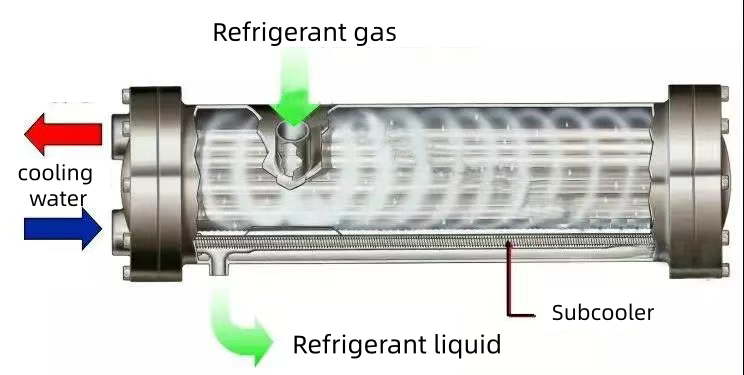
A water- cooled condenser is a chiler component that removes heat fromindustrial processes. t transfers heat rom the refigerant to water, which thencirculates to a cooling tower or heat exchanger. This method ofers efficient heat removal, especially in high-heat environments, making it ideal forequipment that reguires stable temperatures, Regular maintenance, such as cleaning condenser tubes and monitoring water qualty, is important foroptimal performance.
In addition to water-cooled, there are also air-cooled and evaporative condensers. However, all condensers have asimilar function, regardless of type. Their job is to cool a process or equipment by transferring heat away from arefrigerant gas.
Air-cooled condensers use ambient air to cool the refrigerant, Fans blow air over the condenser coils, which releaseheat from the refrigerant. This process effectively lowers the refrigerant temperature before it returns to thecompressor.
Water-cooled condensers use water to absorb and remove heat from the refrigerant. Water circulates through aheat exchanger, picking up heat from the refrigerant and then transferring it to the outside environment via acooling tower or similar system.
A water-cooled condenser works by removing heat from refrigerant vapor and transferring it to water. Here’s a breakdown of the process:
1. Refrigerant Vapor: The refrigerant, heated during the cooling process, enters the condenser as a hot, high-pressure gas.
2. Heat Exchange: Inside the condenser, the refrigerant vapor passes over coils or tubes filled with water. The water absorbs the heat from the refrigerant, causing the refrigerant to cool and condense into a liquid.
3. Heat Dissipation: The now-heated water is circulated out of the condenser and into a cooling tower or heat exchanger, where it releases the absorbed heat into the environment.
4. Cooling Cycle: The cooled refrigerant, now in liquid form, is then cycled back into the system to continue the cooling process, while the water is either cooled and recirculated or replaced.
This ongoing cycle helps the condenser remove heat efficiently, keeping temperatures just right in industrial and commercial settings.
An industrial chiller system’s condenser serves as a heat transfer device between a process and its external environment. Water-cooled chillers typically contain a condenser attached to a cooling tower.
The most common types of water-cooled chillers use water from an external tower to cool the gaseous refrigerant in the condenser. Once the heat is expelled, the refrigerant will undergo a phase change into a liquid to be recirculated into the system.
