Views: 0 Author: Site Editor Publish Time: 2026-10-04 Origin: Site

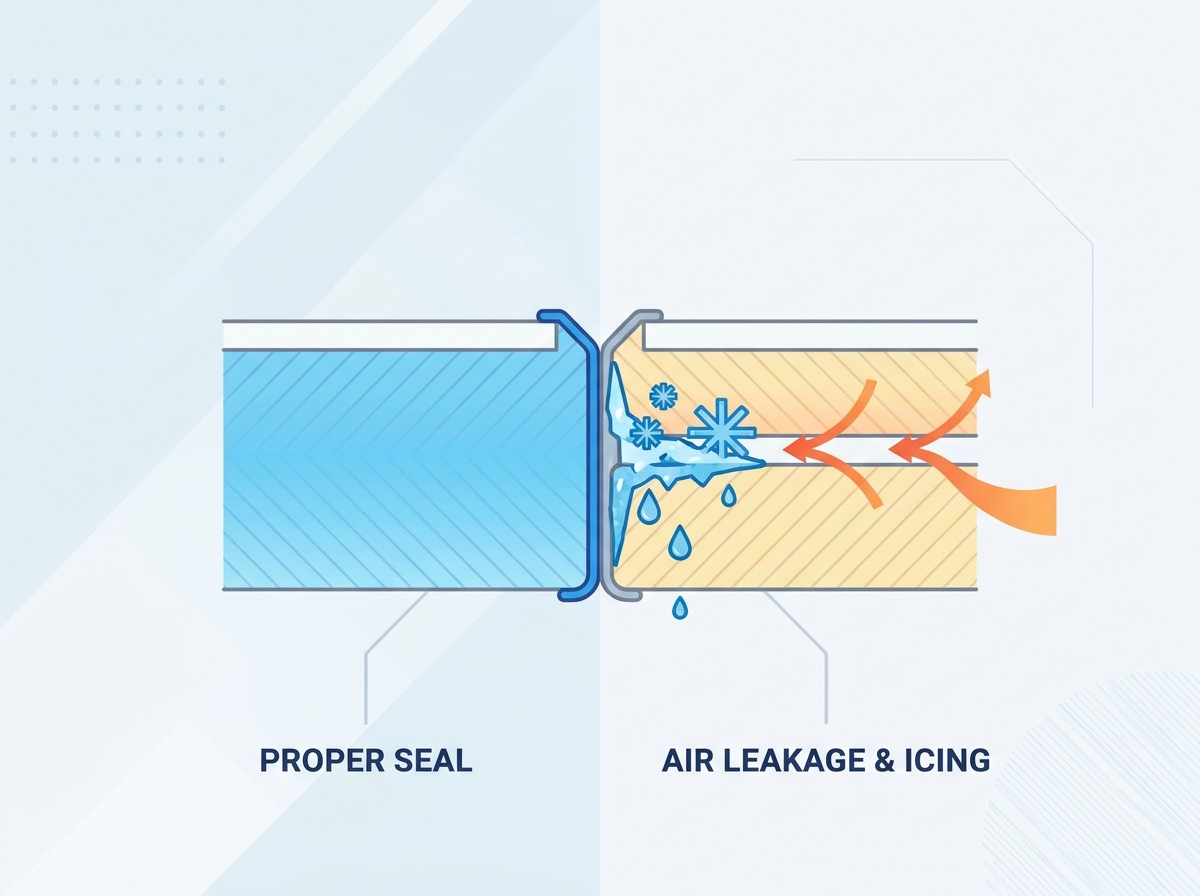
Walking into a temperature-controlled facility and finding condensation, frost, or solid ice along the seams is a harsh operational reality. These issues are not mere cosmetic annoyances. Joint sweating and icing are clear symptoms of critical system failure. Left unchecked, they trigger cascading consequences. You will see exponential energy loss and overworked cooling systems. Hygiene and HACCP compliance become compromised. Ice buildup creates dangerous slip hazards. Eventually, waterlogging causes irreversible degradation of the panel core.
Resolving or preventing these failures requires a deep technical understanding of vapor pressure, thermal bridging, and the specific engineering tolerances of modern panel systems. Surface caulking will not solve a structural vapor leak. You must address the root cause of the moisture ingress. This guide will help you diagnose joint failures and specify the right materials for new builds or retrofits.
Vapor Drive is Relentless: Sweating and icing are primarily caused by warm, humid air infiltrating the cold space due to vapor pressure differentials, condensing when it hits the dew point at compromised panel joints.
Joint Geometry Dictates Performance: The structural design of cold room insulation sandwich panels (e.g., cam-locks, labyrinth joints) directly impacts the long-term viability of the vapor barrier and overall energy savings.
Installation Tolerances are Unforgiving: Both under-compressed joints (allowing air paths) and over-compressed joints (buckling the metal facings) lead to thermal bridging, moisture ingress, and permanent foam degradation.
Holistic System Integrity: Wall and ceiling panels do not operate in isolation; poorly specified cold room doors, sweating registers, and unsealed penetrations frequently drive the pressure imbalances that cause panel joints to fail.
Understanding why joints fail begins with the physics of vapor drive. Air behaves predictably under pressure and temperature changes. High-pressure, warm, moisture-laden air outside the room constantly seeks equilibrium. It pushes relentlessly against the low-pressure, cold, dry air inside the facility. This pressure differential forces moisture through the path of least resistance. In a cold storage envelope, that path is almost always the panel joints.
Consider a standard freezer operating at -20°C located inside a warehouse sitting at 25°C with 60% relative humidity. The vapor pressure pushing against the exterior walls is immense. The moisture wants to move from the warm side to the cold side. If there is even a millimeter of space in the joint assembly, the building physics will force humid air into that gap.
The timeline of failure follows a specific condensation-to-ice cycle. Warm air infiltrates a micro-gap in the joint. As this air travels closer to the interior of the cold room, its temperature drops. Once it hits the dew point, the air can no longer hold its moisture. Water condenses inside the joint profile. In a freezer environment, this condensation quickly turns to ice. Continuous freezing and thawing cycles expand the ice. This expansion physically forces the joint further apart, exacerbating the leak and allowing even more humid air to enter.
This cycle severely impacts refrigeration efficiency. Poor insulation and air infiltration at the joints force the cooling system to work harder. The compressors run longer cycles to maintain setpoints. This drastically increases energy consumption. It also accelerates compressor wear and shortens the lifespan of your mechanical equipment. The system fights a constant battle against incoming heat and moisture, which it was never designed to handle continuously.
To prevent this, you must meet strict success criteria. The baseline requirement for any cold storage envelope is a continuous, unbroken vapor barrier. This barrier must reside on the warm side of the insulation. If the warm side is sealed perfectly, moisture cannot enter the joint. The cold side can then breathe, allowing any trapped moisture to escape without forming ice. Achieving this requires precise engineering and flawless execution during the build phase.
Mechanical failures during installation are the primary culprits for joint sweating. cold room insulation sandwich panels rely on precise alignment. Under-compressed joints leave physical voids. These voids provide transit paths for warm, humid air. The air condenses inside the core. Over time, this moisture permanently degrades the foam's thermal resistance. Conversely, over-compression causes severe damage. Pushing panels together too forcefully distorts the geometry. It buckles the metal facings and breaks factory seals. This creates immediate thermal bridges.
Installation Error | Physical Consequence | Long-Term Impact |
|---|---|---|
Under-Compressed Joints | Leaves physical gaps between panel mating surfaces. | Allows massive vapor drive, internal condensation, and core waterlogging. |
Over-Compressed Joints | Buckles metal skins and crushes internal foam profiles. | Destroys factory seals, creates thermal bridges, and misaligns adjacent panels. |
Missing Warm-Side Sealant | Fails to establish the primary vapor barrier. | Forces the cold-side seal to act as the vapor barrier, trapping moisture inside the joint. |
Improper Fastener Torque | Crushes the panel face around the screw head. | Creates localized cold spots and introduces water ingress points on the roof. |
Thermal bridging occurs when heat transfers directly through highly conductive materials. Improper joint alignment often leads to metal-to-metal contact between the interior and exterior panel skins. Missing thermal breaks allow heat to bypass the insulated core entirely. This creates localized cold spots on the warm side of the panel. Condensation rapidly forms on these cold spots, leading to sweating and dripping along the seam. Fasteners are another common source of thermal bridging. Metal screws driven straight through the panel without nylon washers or thermal breaks act as heat highways, drawing cold temperatures directly to the warm exterior skin.
Sealant degradation is another major failure point. Joint sealants have a finite lifecycle. Thermal cycling causes panels to expand and contract daily. Structural shifting adds mechanical stress. Using incorrect mastics accelerates failure. For example, standard commercial silicone hardens and cracks under these conditions. Installers must use non-skinning butyl sealants for hidden joints. Butyl remains flexible and maintains the vapor barrier despite panel movement. When brittle seals crack, the vapor barrier is breached, and icing begins. UV exposure on exterior-facing joints can also degrade sealants rapidly if they are not properly shielded with metal trim and weather-resistant caulking.
Selecting the right panel system requires evaluating the joint design frameworks. The two primary connection methods are slip-joint and cam-lock systems. Each offers distinct trade-offs depending on the application scale. You must match the joint profile to the specific operational demands of your facility.
Cam-locks provide mechanical pull-together force. A built-in hook and pin draw the panels tight. This system is ideal for smaller modular rooms. It ensures a tight fit even with less experienced crews. The mechanical action compresses the internal gaskets uniformly. Slip-joints, often featuring labyrinth profiles, offer superior scalability. They provide excellent thermal performance for large-scale industrial facilities. However, slip-joints require precise structural alignment and meticulous manual sealing to perform correctly. If the structural steel is out of plumb, a slip-joint will never seal properly, leading to massive air infiltration.
Feature | Cam-Lock Systems | Slip-Joint (Labyrinth) Systems |
|---|---|---|
Mechanism | Internal mechanical hooks and pins | Friction-fit tongue and groove profiles |
Best Application | Small to medium modular cold rooms | Large-scale industrial cold storage facilities |
Installation Speed | Fast, self-aligning pull-together action | Requires careful alignment and structural support |
Vapor Seal Reliance | Mechanical pressure aids the gasket seal | Relies heavily on applied butyl sealants |
Structural Flexibility | Rigid connection, less forgiving of movement | Allows slight movement if detailed correctly |
Core material density directly correlates with joint stability. cold storage panels utilize different insulation types, primarily PIR, PUR, and EPS. Higher-density cores resist dimensional changes better. During extreme temperature pull-downs, low-density foam can shrink. This shrinkage pulls the joints apart. PIR (Polyisocyanurate) offers superior dimensional stability and fire resistance compared to standard PUR (Polyurethane) or EPS (Expanded Polystyrene). Stable cores keep the joints tightly sealed over decades of use. When the core remains dimensionally stable, the vapor barrier remains intact.
Integrated gaskets and sealing profiles add significant value. Factory-applied features mitigate installation errors. Look for double-tongue-and-groove profiles. These create a tortuous path for air, making infiltration difficult. Factory-installed compressible gaskets provide a reliable first line of defense. They maximize energy-saving capabilities by ensuring a uniform seal before the secondary butyl mastics are even applied. When evaluating panel manufacturers, ask for detailed cross-section drawings of their joint profiles to verify the presence of these integrated features.
Wall and ceiling panels do not operate in isolation. Frequent opening of cold room doors creates massive pressure spikes. Without proper air curtains or vestibules, opening a door acts like a vacuum. It literally sucks warm air through microscopic gaps in the panel joints. Managing door usage is critical to maintaining the pressure equilibrium required for joint health. High-speed roll-up doors combined with heated air curtains significantly reduce the volume of humid air entering the space during forklift traffic.
Sweating isn't limited to panel joints. You must look for system-wide symptoms. Condensation on HVAC registers is a major red flag. Rapid frost buildup on evaporator coils is another key indicator. These symptoms point to warm air infiltration. Often, the root cause traces back to compromised doors or poorly sealed panel seams. The moisture has to go somewhere, and it will condense on the coldest surfaces available. If your evaporators are constantly entering defrost cycles, you have a severe vapor barrier breach.
Freezer doors require specific engineering to prevent localized failures. Frame heaters and thermal breaks are absolute necessities. Perimeter heater cables prevent the door gaskets from freezing to the frame. If door heaters fail, localized freezing occurs. This ice buildup can spread to adjacent wall panels, forcing the joints apart. Regular testing of heater cables is a mandatory maintenance task. You should check the amperage draw on these cables monthly to ensure they are functioning correctly.
Gasket wear and alignment directly impact panel health. A worn door gasket allows continuous air leakage. This forces the refrigeration system to run longer cycles. Longer cycles increase the vapor drive against the panel joints. Frame door maintenance as a preventative measure. Replacing a torn door gasket is much easier than repairing a waterlogged wall panel. Facility managers must train personnel to report damaged door sweeps or misaligned hinges immediately.
The most critical sealing details are hidden from view. Once wall panels are joined, the internal seal is completely hidden inside the profile. Applying vapor sealants on the warm side of the joint before the panels are pushed together is vital. You cannot rely on superficial surface caulking. Surface caulking only traps moisture inside the joint if the internal vapor barrier is missing. Installers must run a continuous bead of non-skinning butyl exactly where the manufacturer specifies. This requires discipline and constant supervision during the erection phase.
Managing structural deflection is critical in large facilities. Roof or floor deflection poses severe risks. As the building settles or handles snow loads, the structure moves. This movement can shear panel joints apart. To prevent this, engineers use slip-track details at the ceiling connections. These tracks absorb vertical movement without breaking the vapor seal. Rigidly fastening ceiling panels to a moving roof structure guarantees joint failure. You must allow the insulated envelope to float independently of the primary steel structure.
Routine inspection requires a practical diagnostic framework. Visual inspections often miss micro-leaks. You should use thermal imaging to scan the walls. Cold spots at the joints indicate thermal bridging or missing insulation. Smoke pencil testing helps identify active air leaks around doors and seams. Catching these issues early allows you to repair hidden seals before visible ice forms and permanent damage occurs.
Calibrate your thermal imaging camera to the specific temperature differential of your facility.
Scan all wall-to-ceiling intersections, as these are the most common areas for structural deflection and seal failure.
Perform a smoke pencil test around all door frames while the refrigeration fans are running to simulate operational pressure.
Inspect the exterior warm-side panel joints for any signs of cracked or missing butyl sealant.
Document all cold spots and schedule immediate injection of expanding urethane foam to re-establish the thermal break.
Conduct a comprehensive thermal audit of your existing facility using infrared imaging to locate hidden thermal bridges.
Inspect and replace all worn door gaskets to reduce negative pressure spikes and air infiltration.
Verify the operation of all perimeter frame heaters on freezer doors to prevent localized ice expansion.
Consult with a specialized cold storage engineer to specify the correct panel joint details and sealants for your next retrofit or new build.
A: Warm, moist air is bypassing the vapor barrier through a compromised joint. When this humid air hits the freezing temperatures inside the room, it reaches its dew point and turns directly into frost or solid ice along the seams.
A: You must locate the active air leak, dry the joint completely, and re-establish the vapor barrier. This barrier must be on the warm side of the panel. Use appropriate non-hardening sealants to block the moisture path permanently.
A: Non-skinning butyl sealants are best for hidden joint mating surfaces because they remain flexible under thermal cycling. For exposed sanitary beads inside the room, use specialized low-temperature silicones designed for cold environments.
A: Yes, but surface caulking is only a temporary fix. Permanent repair often requires removing the surface trim, injecting expanding urethane foam to fill internal voids, and thoroughly re-sealing the warm side of the joint.
A: Thermal bridging occurs when heat bypasses the insulation through highly conductive materials, like metal fasteners or touching panel skins. This creates a localized cold spot on the warm side, which rapidly attracts condensation and eventually forms ice.
A: Yes. Leaking door gaskets or excessive open times create pressure imbalances. This vacuum effect forces humid air into the room, which then condenses on the weakest points of the wall panel joints or causes HVAC registers to sweat.
A: Moisture inside the core waterlogs and degrades the foam. This permanently destroys its insulation value. The loss of thermal resistance forces your cooling system to work harder, increasing energy costs and equipment wear.