Views: 0 Author: Site Editor Publish Time: 2026-06-16 Origin: Site

Choosing the right refrigeration piston compressor condensing unit is one of the most important decisions in a cold storage project. Whether the project is a fresh cold room, freezer room, food storage warehouse, supermarket cold room, hotel kitchen storage room, agricultural product preservation room, or logistics cold chain facility, the compressor unit directly affects cooling performance, temperature stability, energy consumption, and long-term maintenance cost.
For many buyers, the refrigeration unit is often compared by price, horsepower, or compressor brand. However, a cold room system is not determined by one parameter alone. A suitable refrigeration piston compressor condensing unit must match the cold room size, target temperature, insulation panel structure, stored products, daily loading volume, ambient temperature, installation location, and control requirements.
At TIANSHUN, cold storage equipment is not treated as isolated products. A compressor unit needs to work together with polyurethane cold room panels, evaporators, condensers, cold room doors, and the overall cold storage design. This article explains how to choose the right refrigeration piston compressor condensing unit for a cold storage project and what buyers should confirm before placing an order.
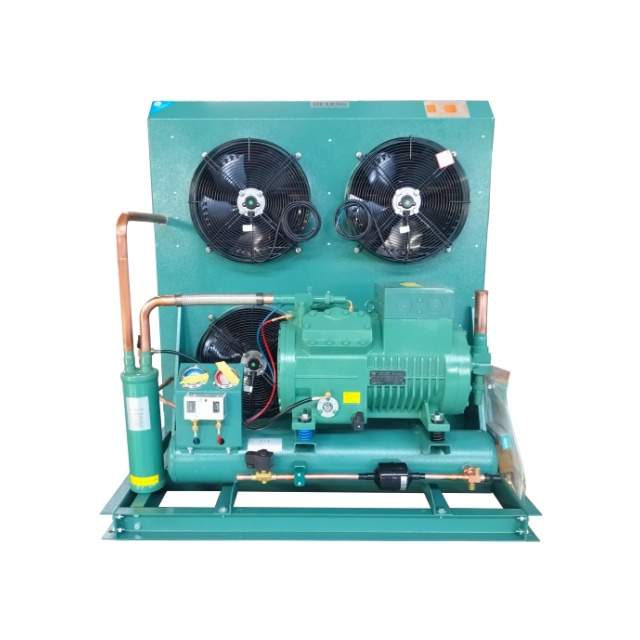
A refrigeration piston compressor condensing unit is a key part of a mechanical refrigeration system. It usually includes a piston compressor, condenser, fan, control box, protection devices, pipeline components, and other necessary refrigeration accessories. Its main function is to compress refrigerant gas, discharge heat through the condenser, and support the cooling cycle of the cold room.
The piston compressor, also known as a reciprocating compressor, compresses refrigerant through the reciprocating movement of pistons inside cylinders. This type of compressor has been widely used in commercial and industrial refrigeration systems for many years. Its structure is mature, serviceable, and suitable for a wide range of cold storage applications.
A refrigeration piston compressor condensing unit is commonly used in:
Fresh cold rooms for fruits, vegetables, flowers, dairy products, and beverages
Chiller rooms for food processing and short-term storage
Freezer rooms for meat, seafood, frozen food, and ice products
Commercial cold rooms for supermarkets, hotels, and restaurants
Agricultural cold storage for harvest preservation
Logistics cold storage for distribution and turnover
Small and medium industrial refrigeration projects
For buyers who need a practical and proven cooling solution, the piston compressor condensing unit remains a widely selected option.
A cold room project can fail not because the equipment is poor, but because the equipment is not suitable for the actual working condition. If the refrigeration piston compressor condensing unit is too small, the cold room may not reach the target temperature quickly enough. The compressor may run continuously, electricity consumption may increase, and product quality may be affected.
If the unit is too large, the initial investment may be higher than necessary. Oversized equipment may also create inefficient operation, frequent start-stop cycles, and unstable humidity or temperature control in some applications.
Correct selection helps the cold room achieve:
Stable temperature control
Faster cooling performance
Lower operating pressure on the compressor
Better energy efficiency
Longer equipment service life
Easier maintenance
Better protection for stored products
More predictable project cost
For this reason, buyers should evaluate the complete cold storage system instead of choosing a compressor unit only by model name or price.
The first step is to define what type of cold room you are building. Different cold rooms have different temperature ranges, cooling loads, and system requirements.
A fresh cold room usually stores products above freezing temperature. It may be used for fruits, vegetables, flowers, eggs, dairy products, beverages, or other temperature-sensitive goods. The main goal is to maintain freshness and slow product deterioration.
A chiller room is often used in food processing, catering, hotel kitchens, and commercial storage. It requires stable medium-temperature refrigeration and reliable daily operation.
A freezer room needs lower temperatures for frozen meat, seafood, frozen vegetables, ice cream, and packaged frozen foods. The refrigeration load is usually higher, and the system must maintain low temperatures continuously.
A blast freezer or quick-freezing room has even higher cooling requirements because it must reduce product temperature quickly within a limited time. In this case, buyers must be more careful when selecting compressor capacity and evaporator configuration.
Before choosing a refrigeration piston compressor condensing unit, the buyer should clearly answer this question: what kind of cold room will the unit serve?
Target temperature is one of the most important factors in equipment selection. A cold room designed for 0℃ to 5℃ storage is very different from a freezer room designed for -18℃ or lower storage. The lower the temperature requirement, the greater the refrigeration challenge.
When communicating with a supplier, buyers should provide both the storage temperature and the expected pull-down requirement. Storage temperature refers to the temperature that must be maintained after the room reaches stable operation. Pull-down requirement refers to how fast the room or products must be cooled after loading.
For example, a cold room that stores pre-cooled vegetables has a different cooling demand from a cold room that receives warm products directly from production or harvest. If warm products enter the cold room every day, the refrigeration unit must handle more product heat load.
Accurate temperature information helps the supplier recommend a more suitable refrigeration piston compressor condensing unit.
Cold room size directly affects cooling load. A larger room naturally requires more cooling capacity, but the calculation is not based on volume alone. The room height, wall area, ceiling area, floor insulation, door size, and layout also matter.
A simple cold room size description should include:
Project Information | Example Details to Provide |
|---|---|
Length | Total internal length of the cold room |
Width | Total internal width of the cold room |
Height | Internal height or usable storage height |
Room type | Fresh room, chiller room, freezer room, or other |
Target temperature | Required storage temperature |
Product type | Meat, seafood, vegetables, dairy, frozen food, etc. |
Daily loading volume | How much product enters the room per day |
Door size | Door opening size and opening frequency |
If the buyer only provides room volume without product and usage details, the selected unit may not be accurate. A cold room with frequent loading and unloading may need more cooling support than a room of the same size used only for stable storage.
Different products require different storage conditions. For example, fruits and vegetables may need stable temperature and suitable humidity to reduce dehydration and preserve freshness. Frozen meat and seafood require low-temperature stability to prevent quality loss. Dairy products and prepared food need controlled storage to support shelf life. Flowers and agricultural products may require gentle cooling and balanced airflow.
The product also affects the cooling load. If products enter the cold room at a high temperature, the refrigeration system must remove more heat. If products are already pre-cooled before storage, the load is lower.
Buyers should provide the following product information:
Product category
Product entering temperature
Required storage temperature
Daily incoming quantity
Packaging method
Storage duration
Turnover frequency
Whether humidity control is important
This information helps determine whether a refrigeration piston compressor condensing unit is suitable and what cooling capacity range should be considered.
The compressor unit is only one part of the cold storage system. Insulation panels play a major role in reducing heat transfer. If the cold room panels have poor insulation performance, even a well-selected refrigeration unit may consume more electricity and operate under higher load.
Polyurethane heat insulation panels are widely used in cold room construction because they provide good thermal insulation performance and help maintain stable temperature. The panel thickness should be selected according to the cold room temperature requirement. In general, lower-temperature rooms require thicker insulation structures than medium-temperature rooms.
When selecting a refrigeration piston compressor condensing unit, buyers should not ignore the cold room panel structure. The unit and the panels must be considered together. A good refrigeration system with weak insulation will still waste energy, while good insulation can reduce compressor workload and improve overall system efficiency.
TIANSHUN provides both refrigeration equipment and cold storage panels, which helps customers consider compressor units, panels, doors, evaporators, and other components as one complete cold room system.
The evaporator, or unit cooler, is responsible for absorbing heat from the cold room. Even if the compressor unit is correctly selected, poor evaporator matching can still cause problems such as uneven room temperature, frost buildup, slow cooling, or excessive energy consumption.
When choosing a refrigeration piston compressor condensing unit, buyers should also confirm:
Evaporator cooling capacity
Airflow design
Fin spacing
Defrost method
Installation position
Air distribution inside the room
Compatibility with the compressor unit
For fresh cold rooms, airflow should be suitable for products that may be sensitive to dehydration. For freezer rooms, defrost design becomes especially important because frost can reduce heat exchange efficiency. For logistics warehouses, strong and uniform airflow may be needed due to frequent door opening and high product movement.
A compressor unit and evaporator must be selected as a matched system.
Ambient temperature affects condenser performance. In summer, outdoor temperature can be high, especially in hot regions or exposed installation areas. If the condenser cannot reject heat effectively, the system pressure may rise, cooling efficiency may decrease, and compressor load may increase.
Buyers should tell the supplier where the refrigeration piston compressor condensing unit will be installed:
Outdoors beside the cold room
On the roof
In a machine room
Inside a factory building
In a high-temperature environment
In a coastal or corrosive environment
In a poorly ventilated area
Good ventilation and maintenance space are important. The condensing unit should not be installed in a closed or hot space without sufficient airflow. For projects in hot climates, condenser selection and installation layout should be reviewed carefully before delivery.
Power supply mismatch is a common problem in equipment procurement, especially for international projects. Before ordering, buyers should confirm voltage, phase, frequency, and electrical standards at the project site.
A refrigeration piston compressor condensing unit may require three-phase power depending on model and capacity. If the site power supply does not match the equipment, installation may be delayed or extra electrical work may be required.
Buyers should provide:
Voltage
Phase
Frequency
Local electrical requirements
Control cabinet needs
Protection requirements
Whether remote control or monitoring is needed
Clear electrical confirmation before shipment helps avoid unnecessary project delays.
Cold storage equipment is a long-term investment. A unit that is difficult to maintain may create higher costs over time. Piston compressor units are valued by many buyers because their structure is mature and practical for maintenance.
Before selecting a unit, buyers should consider whether local technicians can maintain the equipment, whether spare parts can be supported, and whether there is enough space around the unit for inspection.
Maintenance considerations include:
Compressor inspection
Condenser cleaning
Fan operation
Oil level check
Electrical component inspection
Refrigerant system check
Protection device testing
Pipeline connection inspection
A refrigeration system that is easy to inspect and maintain can reduce downtime and improve long-term reliability.
For a cold room project, buying from a supplier that only provides one machine may not be enough. The compressor unit must match cold room panels, doors, evaporators, condensers, and system design. If each part comes from a different supplier without coordination, the buyer may face mismatch risks.
TIANSHUN provides a complete range of cold chain equipment, including cold rooms, cold storage panels, condensing units, evaporators, condensers, cold room doors, and related refrigeration solutions. This is useful for buyers who want better system compatibility and simpler procurement communication.
For contractors, distributors, and overseas customers, one-stop procurement can also help with delivery coordination. Instead of managing multiple suppliers separately, buyers can discuss the complete cold storage system with one manufacturer.
A refrigeration piston compressor condensing unit is a core component of a cold storage system, but the best unit is not always the largest or the cheapest. The right unit is the one that matches the project’s temperature requirement, room size, product load, insulation structure, installation environment, and operating conditions.
For buyers planning a cold room project, accurate information is the foundation of good equipment selection. Cold room type, target temperature, product category, daily loading volume, panel thickness, evaporator matching, condenser condition, and power supply should all be confirmed before ordering.
TIANSHUN supports customers with refrigeration piston compressor condensing units as part of a complete cold chain equipment system. With cold rooms, polyurethane insulation panels, evaporators, condensers, cold room doors, and refrigeration units available within one product range, TIANSHUN helps buyers build cold storage systems with better compatibility and more practical long-term operation.
If you are preparing a fresh cold room, freezer room, logistics cold storage facility, food processing warehouse, supermarket cold room, or agricultural storage project, choosing the right refrigeration piston compressor condensing unit early can help improve cooling performance, reduce operating risks, and support stable cold room operation throughout the year.