Views: 0 Author: Site Editor Publish Time: 2026-10-30 Origin: Site

Selecting the wrong refrigeration architecture leads to chronic thermal inefficiencies, premature equipment failure, and inflated operational expenditures. Facility managers and mechanical engineers face a critical decision when designing cold storage. You must balance the immediate constraints of facility architecture against long-term thermodynamic realities. Installation speed, spatial limits, and labor availability often conflict with heat rejection requirements, ambient temperature control, acoustics, and system longevity.
This engineering conflict defines the foundation of cold room design. You generally choose between two primary architectural approaches. Self-contained packaged systems offer speed and simplicity. Decentralized split systems provide flexibility and heavy-duty performance. Understanding the distinct operational realities of each approach prevents costly retrofits. This guide breaks down the structural, thermodynamic, and maintenance implications of both architectures. You will learn how to match equipment specifications directly to your facility layout and thermal load requirements.
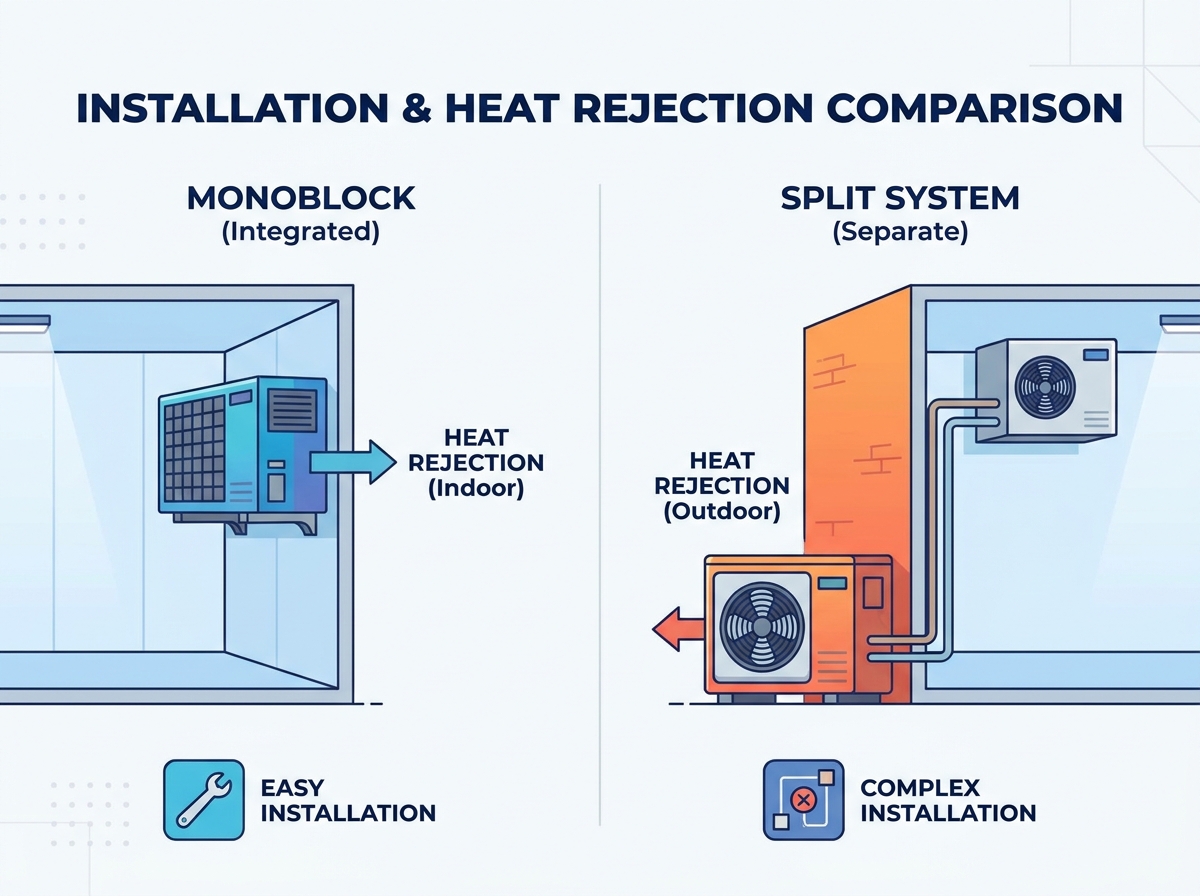
Installation Velocity vs. Complexity: Monoblock refrigeration units offer rapid, factory-sealed deployment but require specific structural accommodations and clearances, whereas split systems demand specialized brazing and refrigerant piping but offer unmatched architectural flexibility.
The Heat Rejection & Acoustic Dilemma: Monoblock systems reject heat and compressor noise directly into the surrounding ambient space, necessitating robust facility ventilation and acoustic planning; split systems isolate heat rejection and noise outdoors, preserving indoor climate control and occupant comfort.
Maintenance and Downtime: Split systems allow for isolated maintenance of external components without breaching the cold envelope, while monoblock servicing often requires localized downtime at the cold room boundary.
Scalability and Redundancy Thresholds: While monoblocks excel in small-to-medium footprints and offer modular redundancy, high-capacity industrial applications typically mandate split systems utilizing heavy-duty components to manage massive thermal loads efficiently.
A packaged system houses the compressor, condenser, and evaporator within a single chassis. Engineers design these systems as factory-assembled, hermetically sealed units. The entire refrigeration cycle occurs within one compact footprint. This design eliminates the need for field-run refrigerant piping. You simply mount the unit, connect the power supply, and configure the digital controller. monoblock refrigeration units represent the standard for this plug-and-play approach.
These systems excel in specific deployment scenarios. Retrofits, leased spaces, and modular expansions benefit heavily from rapid commissioning. Smaller commercial kitchens utilize them to minimize operational disruption during installation. Portability remains a primary driver. If you relocate a modular cold room, the packaged cooling system moves with it seamlessly. You do not have to recover refrigerant or cut copper lines to move the box across a warehouse.
Inherent limitations restrict their use in heavy industrial applications. Capacity ceilings prevent them from handling massive thermal loads. Spatial constraints dictate how and where you can mount them. They release all extracted heat and compressor noise directly into the surrounding indoor environment. This limits their viability in tight, poorly ventilated spaces. When you push a packaged unit beyond its design parameters, you experience rapid component degradation and frequent high-pressure lockouts.
Split systems separate the refrigeration cycle into two distinct physical locations. The architecture decouples the indoor cooling components from the outdoor heat rejection components. You install cold room unit coolers inside the insulated envelope. A remote condensing unit sits outdoors or in a dedicated mechanical room. Customized copper piping networks connect these two halves, carrying liquid and suction refrigerant across the facility.
This decentralized approach becomes mandatory under specific conditions. Large-scale distribution centers require the massive capacity that only decentralized systems can provide. Facilities with strict indoor heat load limits cannot tolerate indoor heat rejection. Multi-room configurations often run off a single, large remote condenser rack. Environments demanding ultra-low noise levels rely on split systems to keep compressor vibration far away from the workspace.
Architectural Feature | Monoblock Refrigeration Units | Split Systems |
|---|---|---|
Component Housing | Compressor, condenser, and evaporator in one chassis | Evaporator indoors; compressor/condenser outdoors |
Installation Requirements | Structural panel cutting, electrical tie-in | Copper brazing, nitrogen purging, vacuum pulling |
Heat Rejection Location | Directly into the surrounding ambient indoor space | Outdoors or in a dedicated mechanical exhaust room |
System Mobility | High; moves easily with modular cold room panels | Low; fixed copper piping anchors the system in place |
Vibration Profile | Transferred directly to the cold room envelope | Isolated to the remote outdoor condensing pad |
Mounting configurations dictate the structural preparation required for packaged systems. Wall-mounted straddle units slide over the insulated panel wall. Ceiling-mounted drop-in units sit flush on the cold room roof. You must verify structural load-bearing requirements for the insulated panels. Heavy units can warp standard cam-lock panels over time if you fail to install proper reinforcement channels. Drop-in units demand strict overhead clearance minimums. Without adequate space above the cold room, the condenser fan cannot pull enough fresh air to reject heat.
Labor requirements differ drastically from traditional HVAC/R installations. You eliminate on-site refrigerant piping entirely. No technicians perform brazing or vacuum pulling. Pre-charged systems reduce reliance on specialized trades during the initial setup. General contractors can often mount the unit, leaving only the final electrical tie-in for licensed electricians. This drastically compresses the construction schedule.
Implementation risks center around physical placement and airflow management. Miscalculated weight distribution leads to structural panel failure. The compressor sits directly on the cold room envelope, creating potential structural vibration transmission. Inadequate clearance causes short-cycling. The unit pulls in its own rejected hot air, driving up head pressure and triggering high-pressure safety lockouts. You must follow a strict sequence to ensure proper deployment:
Verify the structural integrity of the insulated panels to support the unit's static weight.
Measure overhead and lateral clearances to guarantee unobstructed condenser airflow.
Cut the panel opening exactly to manufacturer templates to maintain the thermal seal.
Apply heavy-duty silicone sealant around the chassis perimeter to prevent air infiltration.
Route the condensate drain line to a heated evaporation pan or nearby floor sink.
Infrastructure requirements for decentralized systems introduce significant engineering complexity. You must route liquid and suction lines precisely through the building structure. Engineers calculate exact pipe sizing to maintain refrigerant velocity. Proper pitch ensures oil returns to the compressor. High-quality closed-cell insulation prevents pressure drops, flash gas formation, and external condensation along the piping network. You cannot simply run lines wherever it is convenient; the piping geometry directly impacts compressor survival.
Labor intensity scales up rapidly. You need licensed refrigeration technicians for the entire installation. Facilities must issue hot work permits for brazing copper joints. Technicians flow nitrogen through the pipes during brazing to prevent internal oxidation and carbon scaling. They perform rigorous leak testing with high-pressure nitrogen. They pull deep vacuums below 500 microns to remove moisture before executing on-site refrigerant charging. This extends installation timelines from hours to several days or weeks.
Implementation risks tie directly to field execution. Brazed joints present ongoing risks for refrigerant leaks if not executed perfectly. Oil return issues plague poorly designed piping runs. If lines exceed manufacturer specifications, lack proper P-traps, or involve significant vertical lifts, compressor failure becomes imminent. The compressor pumps oil out into the system but fails to pull it back, leading to fatal mechanical friction and seized bearings.
Piping Consideration | Engineering Requirement | Consequence of Failure |
|---|---|---|
Suction Line Sizing | Must maintain 1000-1500 FPM velocity for horizontal runs | Poor oil return, compressor starvation, bearing failure |
Vertical Lifts | Install P-traps every 15 to 20 feet of vertical rise | Oil logging in the evaporator, reduced cooling capacity |
Insulation Thickness | Minimum 3/4-inch elastomeric foam on suction lines | Condensation dripping on facility floors, heat gain |
Brazing Protocol | Continuous nitrogen purge at 2-3 PSI during brazing | Internal copper flaking, clogged expansion valves |
Thermodynamics dictate that refrigeration does not destroy heat; it moves it. Packaged systems carry a severe heat penalty. They reject 100% of the extracted heat directly into the ambient space surrounding the cold room. The compressor motor also adds its own operational heat to this total. If you install a packaged unit in a closed warehouse, the warehouse temperature will rise steadily. This creates a compounding problem where the unit must work harder to reject heat into an increasingly warm room.
The acoustic footprint requires careful consideration. Housing the compressor indoors introduces continuous mechanical noise. Decibel ratings vary, but compressor cycling noise heavily impacts worker comfort. In commercial kitchens or retail environments, this constant droning causes fatigue and disrupts communication. A standard commercial compressor can generate between 65 and 80 decibels, which echoes off hard warehouse floors and metal ceilings.
Ventilation mitigation becomes a primary engineering requirement. The surrounding room must handle the thermal load. You often need dedicated exhaust fans to pull hot air out of the building. Louver sizing must allow sufficient make-up air. Sometimes, you must integrate the space with the building's primary HVAC system. Failing to mitigate this heat causes ambient overheating, which inevitably leads to high-head-pressure faults on the refrigeration equipment.
You must calculate whether your existing facility can absorb this rejected heat. Evaluate the cubic footage of the ambient space. Measure the existing air exchange rate. Determine if absorbing this heat will trigger secondary cooling demands, forcing your building's AC to work harder. If the ambient space lacks cross-ventilation, you will trap the heat and destroy the refrigeration equipment.
Routing heat to an outdoor condensing unit solves the indoor thermal problem. This approach protects the indoor facility temperature completely. It reduces the load on the building's primary HVAC infrastructure. Furthermore, it entirely removes compressor noise and vibration from the indoor workspace. Employees work in a quieter, temperature-stable environment. You reclaim valuable indoor square footage that would otherwise require massive ventilation clearances.
Outdoor placement introduces weather and ambient fluctuations. You must engineer the system to survive the local climate. Winterization is critical in cold climates. You need crankcase heaters to prevent refrigerant migration into the oil during off-cycles. Fan cycling controls and head pressure control valves maintain adequate pressure when outdoor temperatures plummet. Without these controls, the system cannot feed liquid refrigerant through the expansion valve properly in winter. Extreme weather demands sun shielding and hail guards to protect delicate condenser fins from physical damage.
Evaluate the trade-offs carefully. Weigh the effort of weatherproofing outdoor equipment against the benefits of indoor stability. Running long line sets requires careful planning and core drilling through exterior walls. Yet, the operational stability gained by not having to mechanically cool the indoor space surrounding the cold room justifies the decentralized approach for large facilities.
Densely packed enclosures present distinct accessibility challenges. Engineers compress the compressor, condenser coils, and electrical components into a tight chassis. Accessing these parts often requires working at heights on ladders or scissor lifts. In some cases, technicians must partially remove the unit from the cold room wall or ceiling just to reach a faulty fan motor or contactor. The compact nature means components sit layered over one another, turning a simple sensor replacement into a multi-hour teardown.
Downtime implications are severe during all-in-one failures. If a packaged unit fails catastrophically, replacing the entire chassis is relatively fast. However, repairing internal components on-site proves cumbersome. Opening the unit often temporarily breaches the cold room envelope. You lose temperature control rapidly while the technician works on the open chassis. Facility managers must plan for localized product relocation if a major repair requires pulling the unit off the wall.
Decentralized maintenance offers a distinct operational advantage. Technicians service the condensing unit outdoors. This prevents disruption to the workflow inside the facility. More importantly, servicing the compressor or condenser does not breach the thermal envelope of the cold room. The insulated doors remain shut, preserving product temperature during the repair. Technicians can recover refrigerant, swap a contactor, or clean condenser coils without ever stepping foot inside the warehouse.
Servicing the indoor evaporators requires specific protocols. Maintenance focuses on defrost heater replacement, drain pan cleaning, and fan motor access. You must clear ice buildup from the drain lines regularly. Electric and hot gas defrost mechanisms require periodic testing to ensure they clear the evaporator fins completely during the defrost cycle. A clogged drain line will quickly form an ice block that destroys the evaporator fan blades.
Heavy-duty applications rely heavily on robust compressor technology. semi-hermetic compressor condensing units dominate this space. These compressors offer complete rebuildability. Technicians can access valve plates, stators, and oil pumps in the field. They tolerate variable loads exceptionally well. Their long-term durability in demanding commercial environments far exceeds that of fully hermetic scroll or reciprocating compressors, which you must discard entirely if internal mechanical failure occurs.
System redundancy prevents catastrophic product loss during equipment failure. With packaged systems, you achieve modular redundancy by installing multiple independent units on a single large cold room. If one unit fails, the others continue running. This provides partial cooling capacity, buying time for repairs without losing the entire inventory. You physically separate the mechanical risk across multiple independent chassis.
Decentralized systems achieve redundancy through centralized engineering. You utilize multi-compressor racks or dual remote condensing units. These systems offer highly sophisticated load matching. They cycle compressors on and off based on exact real-time demand. This ensures backup capacity is always available online, though it requires complex piping and control wiring. A rack system can lose a single compressor and still maintain target room temperatures by ramping up the remaining compressors.
Refrigerant regulations heavily influence equipment selection. Factory-sealed packaged units typically contain smaller, critically charged refrigerant volumes. This low charge volume often exempts them from stringent EPA or F-Gas leak tracking and reporting requirements. The hermetic seal drastically reduces the statistical probability of a leak. You avoid the administrative burden of maintaining detailed refrigerant logs for every minor service call.
Decentralized systems face higher regulatory burdens. They hold much larger refrigerant charges due to the extensive piping networks. They possess a higher statistical probability of leaks due to dozens of field-brazed connections. Facility managers must implement rigorous leak detection and mandatory reporting protocols to remain compliant with environmental regulations. A single blown braze joint on a long line set can vent fifty pounds of refrigerant into the atmosphere.
Smart controls integration transforms how you manage both systems. IoT monitoring allows facility managers to track temperature deviations instantly. You monitor defrost cycles, suction pressures, and energy usage in real-time. Cloud-based alerts notify you of high-temperature alarms before product spoilage occurs, shifting maintenance from reactive to predictive. Technicians can log into the system remotely to diagnose a stuck defrost relay before dispatching a truck.
Execute a formal heat load calculation to determine exact BTU requirements before selecting any refrigeration equipment.
Measure your facility's ambient ventilation capacity to confirm it can safely handle indoor heat rejection without overheating the building.
Inspect structural panel load-bearing limits and overhead clearances if you plan to install wall or ceiling-mounted packaged units.
Map out exact piping routes, measure total line length, and calculate vertical lifts to verify split system viability.
Consult with a licensed refrigeration engineer to finalize equipment selection and ensure compliance with local environmental regulations.
A: Capacity limits typically cap out around 3,000 to 4,000 cubic feet for a single packaged unit. Beyond this threshold, the required BTU capacity exceeds the physical size constraints of a single chassis. For larger rooms, you must install multiple packaged units or transition to a decentralized split system to handle the thermal load.
A: You must implement active ventilation. Install dedicated exhaust fans and intake louvers to create cross-ventilation in the ambient space. In tight spaces, tie the area into the building's primary HVAC return. Use acoustic dampening panels on surrounding walls to mitigate compressor vibration and cycling noise.
A: While possible in highly specialized, very large industrial packaged units, it is rare. Semi-hermetic compressors are heavy and generate significant vibration. They are predominantly found in remote condensing units where size, weight, and vibration constraints are easily managed on a concrete outdoor pad.
A: Packaged units offer plug-and-play installation, typically requiring only a few hours to mount, seal, and wire. Split systems require days or even weeks. Technicians must route copper piping, perform brazing, execute nitrogen pressure tests, pull deep vacuums, and manually charge the system with refrigerant.
A: Equivalent line lengths generally max out between 100 and 150 feet, depending on the compressor size and pipe diameter. Exceeding this limits oil return to the compressor. Vertical lifts require specialized P-traps every 15 to 20 feet to help push oil upward against gravity.
A: Both systems commonly utilize electric resistance heaters or off-cycle air defrost. However, decentralized split systems can more easily integrate highly efficient hot gas defrost. This method routes hot discharge gas from the remote compressor directly into the evaporator coils, melting ice much faster than electric heaters.