Views: 0 Author: Site Editor Publish Time: 2026-06-30 Origin: Site

Cold storage demand is closely connected with temperature, production schedules, market requirement, logistics.
This is why TIANSHUN focuses on efficient production coordination, equipment inspection, packaging, and shipment arrangement during the summer delivery season. For customers purchasing refrigeration equipment, timely delivery and reliable product quality are both critical.
At TIANSHUN, the summer delivery season is not only about shipping products out of the factory. It is also about helping customers prepare complete and dependable cold storage systems with the right refrigeration configuration, suitable insulation structure, and practical installation support. Among the equipment prepared for shipment, the refrigeration piston compressor condensing unit remains a widely used choice for many small and medium-sized cold room projects because of its mature technology, serviceable structure, and broad application range.
This article introduces how TIANSHUN prepares refrigeration piston compressor condensing units for summer shipment, why this equipment is commonly selected for cold storage projects, and what buyers should pay attention to when purchasing compressor units during the busy season.
Cold storage demand is closely connected with temperature, production schedules, and supply chain pressure. In summer, food products, fresh produce, meat, seafood, dairy products, flowers, pharmaceuticals, and other temperature-sensitive goods face higher risks during storage and transportation. If the refrigeration system is unstable, even a short period of temperature fluctuation may affect product quality, shelf life, or operating efficiency.
For many project owners, summer procurement usually comes from several practical needs.
First, existing cold rooms may need equipment replacement or capacity upgrades. A compressor unit that worked normally in spring may become overloaded when the outdoor temperature rises. If the cooling capacity is insufficient, the cold room may take longer to pull down temperature, the compressor may run for longer periods, and electricity costs may increase.
Second, many new cold storage projects are planned before harvest season, food processing season, or logistics peak season. Agricultural products, frozen food distribution, and commercial cold chain businesses often need to complete construction before large-volume storage begins.
Third, contractors and distributors need to prepare equipment inventory in advance. During summer, delivery schedules can become tight because many customers place orders within a concentrated period. Choosing a manufacturer with stable production capacity, product categories, and shipment preparation processes becomes especially important.
This is why TIANSHUN focuses on efficient production coordination, equipment inspection, packaging, and shipment arrangement during the summer delivery season. For customers purchasing refrigeration piston compressor condensing units, timely delivery and reliable product quality are both critical.
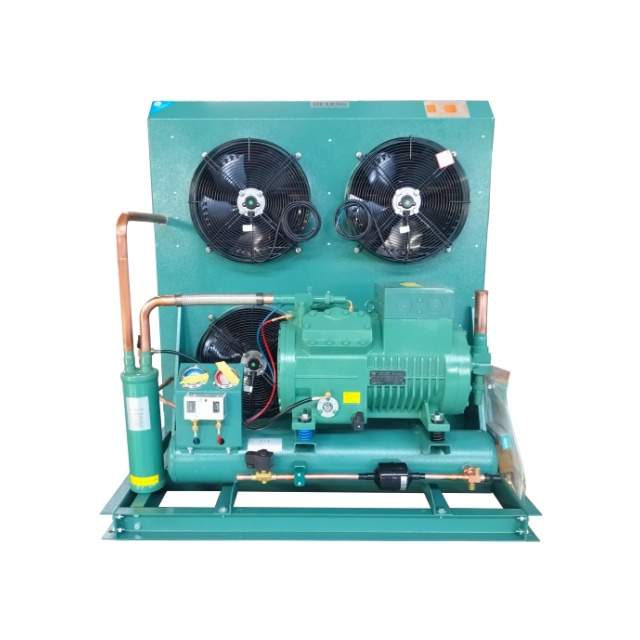
A refrigeration piston compressor condensing unit is a key part of a cold room refrigeration system. It usually combines a piston compressor, condenser, fan, control components, protective devices, and other necessary refrigeration parts into one unit. Its core function is to compress refrigerant gas, discharge high-pressure refrigerant to the condenser, and support the continuous cooling cycle of the cold storage system.
The piston compressor, also called a reciprocating compressor, uses piston movement inside cylinders to compress refrigerant. This technology has been widely used in commercial and industrial refrigeration for many years. Compared with some other compressor types, piston compressor units are known for their mature structure, practical maintenance, and good adaptability across different cooling requirements.
For cold room projects, the refrigeration piston compressor condensing unit is commonly used in applications such as:
Fresh cold rooms for fruits, vegetables, dairy products, and flowers
Chiller rooms for food processing and short-term storage
Freezer rooms for frozen meat, seafood, and packaged frozen food
Small and medium-sized logistics cold storage facilities
Supermarket and commercial refrigeration rooms
Hotel, restaurant, and catering cold storage
Agricultural product preservation projects
The final selection still depends on project conditions, including required temperature, cold room size, insulation thickness, door opening frequency, product loading volume, ambient temperature, refrigerant type, and installation environment.
Although screw compressor units, scroll compressor units, and integrated condensing units are also widely used in refrigeration systems, piston compressor condensing units still hold an important position in many cold room projects. Their popularity comes from a combination of technical maturity, flexible matching, and practical maintenance.
For many buyers, stability is more important than pursuing complicated technology. Piston compressors have a long history of application in refrigeration systems. Their working principle is clear, the structure is familiar to refrigeration technicians, and spare parts are relatively easier to understand and maintain.
This makes refrigeration piston compressor condensing units suitable for projects where customers value proven operation, practical maintenance, and reliable cooling performance.
Cold storage projects often have different temperature requirements. A fresh cold room may only need a temperature range above freezing, while a freezer room may need much lower temperatures. Piston compressor units can be configured for different working conditions based on project design.
For example, a food storage project may require stable temperature control for daily turnover, while a frozen product warehouse may need stronger cooling performance to maintain low-temperature storage. With proper system design, the piston compressor condensing unit can support different cold room scenarios.
Cold room equipment is not a short-term purchase. Once installed, the system may operate for many years. Therefore, serviceability is an important consideration. A piston compressor unit with a practical structure allows technicians to inspect, maintain, and replace key components more conveniently.
For distributors, contractors, and end users, this can reduce long-term maintenance pressure. During the summer season, when refrigeration equipment often runs under heavier load, easy maintenance becomes even more valuable.
A compressor unit cannot work alone. It must be matched with evaporators, condensers, cold room panels, cold room doors, and control systems. One advantage of purchasing from a cold chain equipment manufacturer with a complete product range is that the refrigeration unit can be considered together with the overall cold room structure.
TIANSHUN provides cold storage equipment such as compressor units, polyurethane insulation panels, evaporators, condensers, cold room doors, and complete cold room solutions. This makes it easier for customers to discuss the compressor unit not as a single machine, but as part of a complete temperature control system.
During the summer procurement period, factory shipment is more than loading equipment into trucks or containers. For refrigeration equipment, every shipment should be connected with production quality, product protection, and project coordination. TIANSHUN pays attention to several key stages before refrigeration piston compressor condensing units are delivered.
Before shipment, the first step is confirming the technical requirements of the cold storage project. Different projects may need different compressor configurations, cooling capacities, control methods, installation layouts, and supporting accessories.
For a fresh cold room, the design focus may be stable temperature and product freshness. For a freezer room, the priority may be low-temperature performance and reliable operation under heavier load. For a logistics warehouse, the system may need to handle frequent door opening and large product turnover.
By confirming project information before production and delivery, TIANSHUN can help customers reduce mismatch risks and improve the suitability of the refrigeration piston compressor condensing unit.
A compressor unit is the heart of the refrigeration system. If the unit has quality problems, the entire cold room project may be delayed. For this reason, inspection before delivery is an essential step.
Before shipment, key points generally include checking the compressor, condenser, fan, control box, electrical components, protective devices, pipeline connections, and overall appearance. The purpose is to make sure the unit is prepared for installation and can support stable refrigeration performance after commissioning.
For buyers in summer, this step is especially important. Since the installation schedule is often tight, receiving equipment that has been checked before delivery can reduce unnecessary delays at the project site.
Refrigeration piston compressor condensing units contain mechanical, electrical, and refrigeration components. During long-distance transportation, protection against vibration, moisture, collision, and surface damage is important.
Factory packaging should consider the size and structure of the unit, the transportation method, and the customer’s receiving conditions. Proper packaging helps keep the equipment safe during loading, shipping, unloading, and temporary storage before installation.
For international customers or long-distance domestic projects, packaging quality directly affects the smooth arrival of equipment. This is why shipment preparation is a key part of the summer delivery process.
Many customers do not purchase compressor units alone. They may also need polyurethane cold room panels, evaporators, condensers, cold room doors, and other supporting equipment. If these components come from different suppliers without coordination, the project may face problems such as inconsistent specifications, delayed delivery, or installation mismatch.
TIANSHUN’s advantage is its complete cold chain equipment product system. For customers planning cold storage construction, purchasing compressor units together with insulation panels and other accessories can simplify communication and improve project efficiency.
In summer, when installation time is limited, one-stop procurement can help project owners and contractors reduce coordination pressure.
For buyers preparing summer cold storage projects, choosing the right refrigeration piston compressor condensing unit should not only depend on price. A low initial price may lead to higher energy consumption, unstable cooling, or maintenance problems if the unit is not suitable for the project.
Here are several key factors to evaluate before placing an order.
The first question is the target temperature. A chiller room, fresh cold room, freezer room, and blast freezing project require different refrigeration designs. The compressor unit must match the working temperature range and cooling load.
If the temperature requirement is not clearly confirmed, the selected unit may be too small or unnecessarily oversized. Both situations can create problems. An undersized unit may run continuously and fail to reach the required temperature. An oversized unit may increase investment cost and cause inefficient operation.
The size of the cold room directly affects the cooling load. Wall thickness, ceiling structure, floor insulation, and panel material also influence the final equipment selection.
Polyurethane heat insulation panels are widely used in cold room construction because they help reduce heat transfer and support stable temperature control. If the insulation structure is strong, the refrigeration system can work more efficiently. If insulation is poor, even a good compressor unit may struggle to maintain temperature and consume more energy.
This is why buyers should evaluate compressor units and cold room panels together instead of treating them as separate purchases.
Different stored products bring different refrigeration loads. Fresh vegetables, frozen meat, seafood, dairy products, beverages, flowers, and pharmaceuticals all have different storage requirements. Product loading temperature, daily incoming quantity, packaging method, and turnover frequency will affect cooling demand.
For example, a cold room used only for holding pre-cooled goods requires a different configuration from a room that receives warm products every day. Before ordering a refrigeration piston compressor condensing unit, buyers should provide clear product and loading information.
Summer procurement makes ambient temperature especially important. A condensing unit installed in a hot outdoor environment needs sufficient heat rejection capacity. Ventilation around the unit should also be considered. Poor ventilation may reduce condenser efficiency and increase compressor pressure.
The installation environment should allow enough space for air circulation, maintenance access, and safe operation. Buyers should discuss whether the unit will be installed indoors, outdoors, on a roof, beside a cold room, or in a machine room.
Before shipment, the buyer should confirm the local power supply, voltage, frequency, and control requirements. Electrical mismatch can delay installation and commissioning. Some projects may also require specific control panels, protection devices, or monitoring functions.
Clear communication before production and shipment helps avoid problems when the equipment arrives at the project site.
Many cold storage projects become urgent only when the temperature rises or when products are ready for storage. However, refrigeration equipment procurement should not be left until the last moment.
Ordering earlier in the summer season provides several benefits.
First, it gives more time for technical communication. A refrigeration piston compressor condensing unit should be selected based on project needs, not simply chosen from a general product list. Early communication allows engineers and sales teams to confirm cold room size, temperature requirements, panel configuration, evaporator matching, and delivery schedule.
Second, it helps avoid production and shipping congestion. During peak season, many customers place orders at the same time. Earlier ordering can improve scheduling certainty and reduce project delays.
Third, it gives contractors more time for installation preparation. Site foundation, drainage, electrical wiring, cold room panel installation, pipe connection, and commissioning all require coordination. When the compressor unit arrives at the right time, the project can move forward more smoothly.
Fourth, it reduces operational risk. If an old cold room system is already under pressure, waiting too long may increase the chance of breakdown during hot weather. Replacing or upgrading equipment in advance can help maintain stable operation during peak demand.
TIANSHUN is not only a supplier of refrigeration piston compressor condensing units. The company provides a broader cold chain equipment system, including cold rooms, condensing units, polyurethane insulation panels, evaporators, condensers, cold room doors, drying equipment, and related refrigeration solutions.
For customers, this means the compressor unit can be selected together with the whole cold storage system. Instead of buying different components from several suppliers, customers can communicate project requirements more efficiently and reduce the risk of specification mismatch.
This is especially valuable for overseas buyers, distributors, contractors, and project owners who need stable supply, technical communication, and product consistency. Whether the project is used for food processing, logistics warehousing, agricultural storage, hotel dining, commercial refrigeration, or other temperature-controlled applications, system matching is essential.
A refrigeration piston compressor condensing unit can deliver better value when it is combined with proper insulation panels, correctly selected evaporators, suitable condensers, reliable cold room doors, and professional installation planning.
Before confirming shipment of a refrigeration piston compressor condensing unit, buyers can review the following checklist:
Item | What to Confirm |
|---|---|
Cold room type | Fresh room, chiller room, freezer room, or special storage room |
Target temperature | Required storage temperature and pull-down requirements |
Room dimensions | Length, width, height, and total storage volume |
Insulation panel | Panel thickness, material, and installation structure |
Stored products | Product type, loading temperature, and daily turnover |
Power supply | Voltage, phase, frequency, and site electrical conditions |
Installation location | Indoor, outdoor, machine room, roof, or side installation |
Matching equipment | Evaporator, condenser, cold room door, control box, and accessories |
Delivery schedule | Required arrival time and project installation plan |
After-sales support | Maintenance access, spare parts, and technical communication |
Using this checklist before shipment can help reduce communication errors and make the final installation process more efficient.
The summer delivery season is a critical period for cold storage equipment procurement. For customers preparing new projects or upgrading existing cold rooms, the refrigeration piston compressor condensing unit is one of the most important pieces of equipment to confirm early.
A good compressor unit should not only meet cooling capacity requirements. It should also match the cold room structure, insulation performance, product storage needs, ambient conditions, and long-term maintenance expectations. This is why choosing a supplier with complete cold chain equipment capability is important.
TIANSHUN prepares refrigeration piston compressor condensing units for shipment with attention to project requirements, quality inspection, packaging protection, and system matching. With a product range covering compressor units, cold storage panels, evaporators, condensers, cold room doors, and complete cold room solutions, TIANSHUN helps customers build more reliable and efficient refrigeration systems for summer and beyond.
If you are planning a cold storage project during the summer procurement season, early consultation and equipment selection can help you secure a smoother delivery schedule, better system compatibility, and more stable cold room operation.