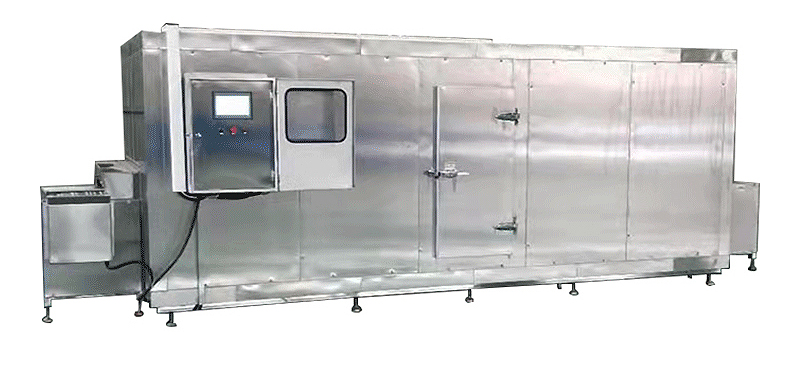
Blast Freezer Room
TianShun
| Availability: | |
|---|---|
| Quantity: | |
|
Product Description
A blast freezer room cools its contents quickly, rapidly dropping the temperature. Flash freezing in a blast freezer is one of the safest and most effective ways of preventing bacterial growth.
Blast freezer rooms are sometimes referred to as shock freezers. The idea of this type of freezer room is to very rapidly bring down the temperature of (usually) foodstuffs or fresh produce, freezing them very quickly.
Principally, the body or panel thickness of a standard blast freezer ranges between 140 to 200mm thick, and of 40kg/m3 or more, panel density. The kind of door for this application must be as thick as the body panel to reduce or eliminate heat ingress.
Blast freezer room holds temperatures between minus 28 degrees down to a chilly minus 40 degrees. As a result, the ice crystals that form in the process are small, causing less damage to the products. This captures the product's freshness and nutritional value.
|
What is Quick Freezing
This is a rapid freezing of food by exposure to a very low temperature blast of air. Unlike normal freezing, very small ice crystals are formed that do not rupture the food cells, and thus the structure is relatively undamaged and nutritional value is preserved.
Quick-freezing is a two-stage process wherein a product (food) is rapidly cooled by a “blast” of very cold air to a temperature just below 0° C and held there for 2 hours and then rapidly cooled to a temperature between –250 C or lower. The crystal formations within the cellular structure of the food is kept very small by this method, resulting in less cellular damage.
|
What are the different types of Blast freezers?
Mini blast freezer: This is usually a standing model with slim doors. It has limited capacity for few items. It’s not a walk-in freezer. It is manually loaded with items as a very small processing facility with temperature at -25o C.
Commercial Blast freezer : This is about the most common type in the market. It’s a walk-in model widely used in farms, abattoirs, and other food processing facilities. It’s operating temperature ranges from -25 to -40o C.
Tunnel blast freezer: This is a specially designed blast freezer with conveyor. The conveyor takes items in and out of the blast freezer. Warm items conveyed in comes out frozen and then bagged or packaged onward to the storage room.
Temperature ranges between -40 to -60o C for a tunnel blast which is applicable in large processing facilities and packaging industries where produce are expected to be frozen within minutes.
This is possible because of the temperature that is extremely low. The use of conveyor that replaces human traffic to and from the blast chamber is also an enormous advantage. Blast freezing temperature is maintained because of the perfect body insulation, standard heat proof door and higher refrigerating unit capacity used.
Shock Blast freezer: This is another type of specially designed quick freezer designed with a temperature range from -40 to -85o C. This is used mainly in pharmaceutical environment for processing and storage of bio-pharmaceutical products.
|
Product Description
A blast freezer room cools its contents quickly, rapidly dropping the temperature. Flash freezing in a blast freezer is one of the safest and most effective ways of preventing bacterial growth.
Blast freezer rooms are sometimes referred to as shock freezers. The idea of this type of freezer room is to very rapidly bring down the temperature of (usually) foodstuffs or fresh produce, freezing them very quickly.
Principally, the body or panel thickness of a standard blast freezer ranges between 140 to 200mm thick, and of 40kg/m3 or more, panel density. The kind of door for this application must be as thick as the body panel to reduce or eliminate heat ingress.
Blast freezer room holds temperatures between minus 28 degrees down to a chilly minus 40 degrees. As a result, the ice crystals that form in the process are small, causing less damage to the products. This captures the product's freshness and nutritional value.
|
What is Quick Freezing
This is a rapid freezing of food by exposure to a very low temperature blast of air. Unlike normal freezing, very small ice crystals are formed that do not rupture the food cells, and thus the structure is relatively undamaged and nutritional value is preserved.
Quick-freezing is a two-stage process wherein a product (food) is rapidly cooled by a “blast” of very cold air to a temperature just below 0° C and held there for 2 hours and then rapidly cooled to a temperature between –250 C or lower. The crystal formations within the cellular structure of the food is kept very small by this method, resulting in less cellular damage.
|
What are the different types of Blast freezers?
Mini blast freezer: This is usually a standing model with slim doors. It has limited capacity for few items. It’s not a walk-in freezer. It is manually loaded with items as a very small processing facility with temperature at -25o C.
Commercial Blast freezer : This is about the most common type in the market. It’s a walk-in model widely used in farms, abattoirs, and other food processing facilities. It’s operating temperature ranges from -25 to -40o C.
Tunnel blast freezer: This is a specially designed blast freezer with conveyor. The conveyor takes items in and out of the blast freezer. Warm items conveyed in comes out frozen and then bagged or packaged onward to the storage room.
Temperature ranges between -40 to -60o C for a tunnel blast which is applicable in large processing facilities and packaging industries where produce are expected to be frozen within minutes.
This is possible because of the temperature that is extremely low. The use of conveyor that replaces human traffic to and from the blast chamber is also an enormous advantage. Blast freezing temperature is maintained because of the perfect body insulation, standard heat proof door and higher refrigerating unit capacity used.
Shock Blast freezer: This is another type of specially designed quick freezer designed with a temperature range from -40 to -85o C. This is used mainly in pharmaceutical environment for processing and storage of bio-pharmaceutical products.